No. 1912.10.16 · Dead Ball Era
Snodgrass's Muff
With the Giants one win from a title, Fred Snodgrass dropped a routine fly to open the tenth. He then made a fine catch that the nickname forgot.
Shame meter
Loading the votes.
One anonymous score, and it stays.
Trend
Loading the votes.
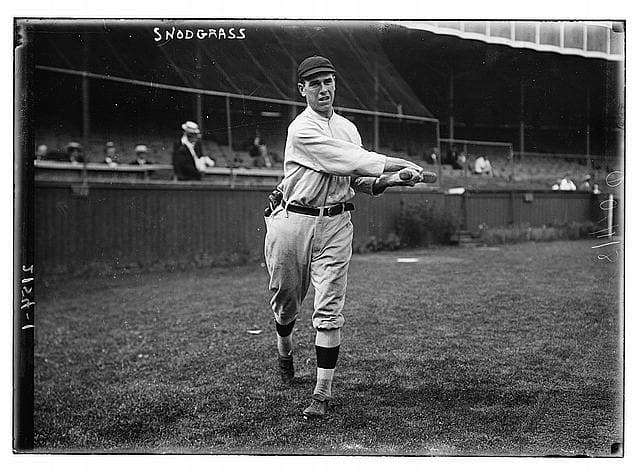
Fred Snodgrass of the New York Giants in 1911, the year before the dropped fly. The negative is labeled with his name.
Public domain. Bain News Service, Library of Congress, via Wikimedia Commons.
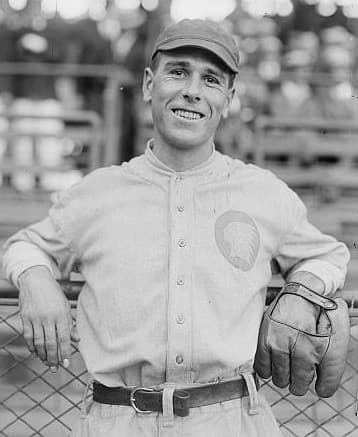
Fred Snodgrass. The portrait predates the reputation the tenth inning gave him.
Public domain. George Grantham Bain Collection, via Wikimedia Commons.
The 1912 World Series needed an eighth game because one of the first seven had ended in a tie. On October 16 at Fenway Park, Christy Mathewson carried a 2–1 lead into the bottom of the tenth. Clyde Engle led off with a routine fly to center. Fred Snodgrass dropped it, and Engle reached second.
The inning did not belong to that drop alone. Snodgrass then ran down Harry Hooper's long drive and caught it. Steve Yerkes walked. Tris Speaker lifted a foul pop that Mathewson, first baseman Fred Merkle, and catcher Chief Meyers all hesitated on; it fell safely. Speaker singled Engle home. Larry Gardner's sacrifice fly scored Yerkes, and Boston won, 3–2.
The error picked up the nickname the "$30,000 muff," a figure that overstated the actual gap between the winners' and losers' shares. Snodgrass spent the rest of his life attached to the drop. The catch on Hooper happened in the same half-inning.